
Neshoba LEC Release Paths
The Neshoba County Law Enforcement Center, also called the Neshoba County Detention Center, is the sheriff-run local jail in Philadelphia. Its records distinguish a release to the community from an exit that leaves the person in custody. The dated NCDC Arrest/Release Report found in the research uses methods such as BONDED OUT, RELEASED OWN RECOGNIZANCE, RELEASED BY JUDGE, and TRANSFERRED TO ANOTHER AGENCY. Those labels should be preserved when reporting what happened. They are not synonyms.
Bond or recognizance ends that jail stay while the court case may remain open. A judge-ordered release proves judicial authority but does not, by itself, state whether the cause was dismissal, time served, a changed sentence, or some other order. A transfer proves only that Neshoba County relinquished custody to another agency. It does not prove release to the community. Ask the jail for the receiving agency, then continue with MDOC, another county, tribal custody, or the supported federal system.
| Recorded event | What it establishes | Next confirmation |
|---|---|---|
| Bonded out | The Neshoba booking ended on bond | Match the jail time to the court bond order |
| Own recognizance | The person left without a cash bond shown | Read the court order and later docket |
| Released by judge | A judicial order authorized the exit | Obtain the order for its actual reason |
| Transferred | The local custodian changed | Identify and search the receiving agency |
Confirm Neshoba LEC Releases
The strongest immediate local proof pairs the released timestamp and method with the same booking number and date of birth. The public artifact discovered during research is a dated, roughly eight-day report, not a live 24-hour or 72-hour feed. It mixes arrest entries with release and transfer entries. A blank release field means the selected report did not show a release for that entry when printed. It cannot prove the person is still held now.
Use a short, source-based sequence. The NCDC Arrest/Release Report is useful when its date range covers the booking. The official sheriff app may supply a present-custody clue, but no verified release archive or retention period was found. The durable route is the jail docket or written record response. The broader Neshoba County released inmate search explains how court, MDOC, SAVIN, and federal sources fit after the custodian is known.
- Match the full name with the booking number, date of birth, and booked time when available.
- Read both the released date and the exact “How Released” field. Do not infer the method from roster absence.
- For a transfer, call the Law Enforcement Center and request the receiving-agency notation.
- For a bond or judge release, compare the jail event with Justice Court or Circuit Court records.
- For an older event, file a bounded written request for the jail docket, timestamp, method, and transfer detail.
Important: Leaving the Neshoba County jail roster may mean release, transfer, correction, or an update delay. The roster alone does not select among them.
Neshoba LEC Record Fields
The local report carries more detail than a basic current roster. Its text can include the event label, name, race, sex, birth date, custody class, arresting agency and officer, booking number, ID number, booked date and time, released date and time, address data, charge, statute or charge code, bond, and release method. A reader should capture only the fields needed to match the custody episode and understand its end. Names repeat, and one person may have more than one booking.
Release data answers when and how this custodian gave up control. It does not resolve guilt or give the final court result. The court docket can show the bond order, dismissal, plea, sentence, credit, probation, revocation, or judgment. In contrast, the jail record supplies the operational release time. If exact timing and legal authority both matter, use both records and keep their roles separate.
- Release method
- The jail’s label for how its custody episode ended.
- Receiving agency
- The next custodian when the event was a transfer.
- Disposition
- The court’s outcome for the case, which is separate from physical release.
- Discharge
- The end of a sentence or supervision, not merely departure from this jail.
Note: “Not shown in this source” is the accurate description of a blank field; “none” makes an unsupported claim.
Request Neshoba LEC Records
Neshoba County routes public-record requests through the Chancery Clerk, who serves as Public Records Officer. The county policy accepts a written form, letter, fax, or email, not a qualifying request by telephone or in person. Give a bounded date range and enough identifying detail to locate the booking. Ask for the booked timestamp, released timestamp, exact release method, and receiving agency if transferred. Request the booking photograph separately so a decision about the image does not obscure responsive text.
The policy says the county will make records available, give an estimate, seek clarification, or deny within seven business days. Inspection is available at the clerk’s office on weekdays from 8:00 a.m. to 5:00 p.m., except legal holidays. Copy and search costs may apply. An already available electronic record sent by email has no email charge under the policy. If part of a record is exempt, the county should release the nonexempt part and explain the specific basis for withholding.
Neshoba County Public Records OfficerChancery Clerk
401 East Beacon Street, Suite 107
Philadelphia, MS 39350
Phone: 601-656-3581
Fax: 601-656-5915
Email: chanceryclerk@neshobacounty.net
A denial may be submitted for internal written review. The county administrator must affirm or reverse it within two business days after receiving the review petition. Ethics Commission and court review remain later routes under the county policy and Mississippi law.
The published fee schedule is also specific. Black-and-white copies cost $0.50 per page, color copies cost $0.75 per page, and scanning costs $0.25 per page. Actual media, mailing, and qualified search, review, or redaction expenses may be added, and advance payment can be required. Ask for a cost estimate before broad work begins, then claim or review assembled records within the policy's 30-day window after notice.
Neshoba LEC Contact Details
Call the facility when present custody or an unknown receiving agency needs quick clarification. A call can guide the next search, but it is not the same as a durable jail record. No official public source identified a standard release hour, exit point, waiting area, transportation plan, weekend rule, or property-return process. Ask the center directly about those logistics rather than relying on a general jail practice.
Neshoba County Law Enforcement Center920 Chestnut Street
Philadelphia, MS 39350
Phone: 601-656-1414
Fax: 601-650-3281
Email: lawcenter@neshobacounty.net
Jail Administrator Amanda Wilkerson is named on the county source. Sheriff Eric Clark’s office, deputies, and investigators also operate from the center. Because officeholders and staff can change, verify a named contact against the current Neshoba County Sheriff page before directing a time-sensitive request.
Neshoba LEC Release Site History
The current Law Enforcement Center has a specific local history. Neshoba County says it opened in January 1995 after construction lasting less than seven months. The reported project cost was $1.8 million. The building exceeds 15,000 square feet and was described as an early use of factory-assembled, welded-steel detention units. Its stated capacity includes 52 maximum-security beds plus 12 work-crew beds.
This is not the former Philadelphia jail. The Mississippi Department of Archives and History identifies the old 1954 jail at 422 East Myrtle Avenue as a historic-district property. Present release questions belong at 920 Chestnut Street. Keeping those sites distinct prevents a records request, ride plan, or custody call from going to a former building.
The matching manifest image comes from the Mississippi Ethics Commission public-records overview.
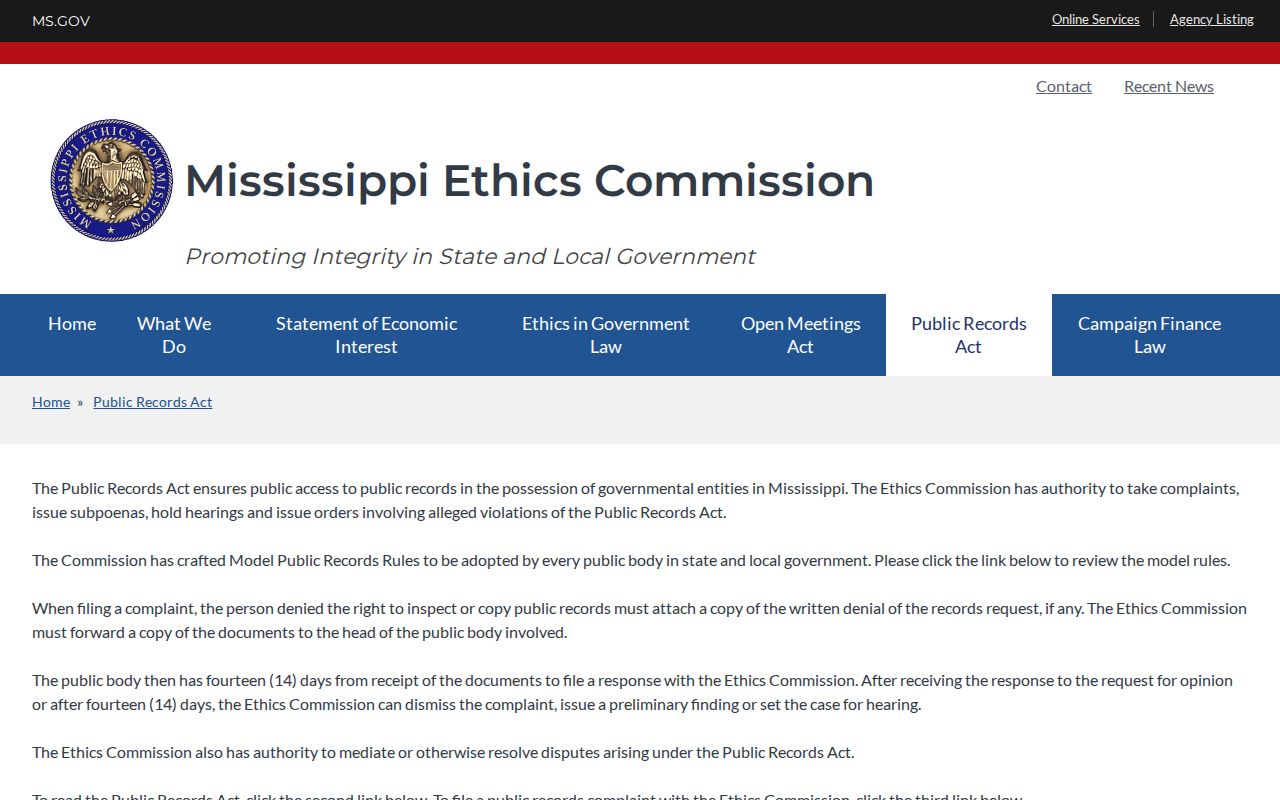
That state access overview supports the formal request route when the dated local report or present roster cannot establish the release event.
Neshoba LEC Custody Boundaries
Neshoba County has more than one custody system. Choctaw Adult Detention is operated by Mississippi Band of Choctaw Indians Public Safety under Choctaw Court jurisdiction. The youth facility is also tribal and must remain outside an adult public locator. The Kemper/Neshoba regional facility is physically in DeKalb, Kemper County, and state inmates there follow MDOC search and discharge routes. The joint name does not make it this sheriff-run jail.
Start every release search with the actual custodian during the dates at issue. A county charge does not prove county detention. Likewise, a person can leave the Neshoba Law Enforcement Center through a transfer and remain confined. County records should establish the transfer, while the receiving agency must establish any later community release or discharge.