
Neshoba Parole and Probation Compared
Parole and probation both allow a person to live outside a secure facility under conditions, but the legal source differs. The Mississippi State Parole Board may grant parole after a state prisoner reaches eligibility. The sentence remains active, and MDOC Community Corrections handles community supervision. Probation comes from a court order. It may be imposed instead of incarceration, combined with a short jail term, or ordered as part of a sentence. Neither label states when the Neshoba County jail processed a person out.
Use the status shown in the official record. An eligibility date only means the Board may consider parole. It does not show a grant, physical release, or final discharge. A probation order proves court supervision, but it does not prove that every hold was cleared. The county jail record supplies its own release time and method. State prison release is documented through MDOC records.
| Point | Parole | Probation |
|---|---|---|
| Who orders it | Mississippi State Parole Board | The sentencing court |
| Custody path | Conditional release from a state prison sentence | A court term that may follow jail or replace prison |
| First online check | MDOC Parolees Search | Court docket, then MDOC when Community Corrections administers it |
| Ending record | Official discharge or Board and MDOC record | Court or MDOC completion and discharge record |
- Parole
- Conditional release approved by the Board while the sentence remains in force.
- Probation
- Court-ordered supervision in the community.
- Discharge
- Formal completion of the sentence or supervision term.
- Absconder
- A person alleged to have stopped required contact or whose location is unknown.
Verify Neshoba Post-Release Supervision
Begin with identity and the correct custody episode. MDOC provides separate inmate and parolee forms. Both accept first name, last name, or MDOC ID. A name can repeat, so compare the MDOC ID, date of birth, offense, county of conviction, and sentence information. The inmate form describes a state sentence or current placement. The parolee form addresses post-release state supervision. Neither is an index of a routine bond release from the Neshoba County Law Enforcement Center.
- Open the MDOC search forms and run the inmate search with the best known name or MDOC ID.
- Run the separate Parolees Search. Match more than the name and record the date checked.
- Read the exact status. Keep parole eligibility, a parole grant, physical release, and discharge as four distinct facts.
- For an individual Board action, contact the Mississippi State Parole Board. No verified current public decisions portal or hearing calendar was found.
- Use the local Community Corrections office for reporting-office procedure. Do not expect confidential officer notes.
- For a durable state record, ask MDOC Records for the nonexempt release, discharge, or time record tied to the correct MDOC ID.
For a Neshoba jail release, pair supervision information with the jail docket, Arrest/Release report, or court order. A person can bond out on one case while another hold remains. A transfer from the county jail to MDOC is not community release. The complete county release path and record fields are covered on the Neshoba County released inmates search.
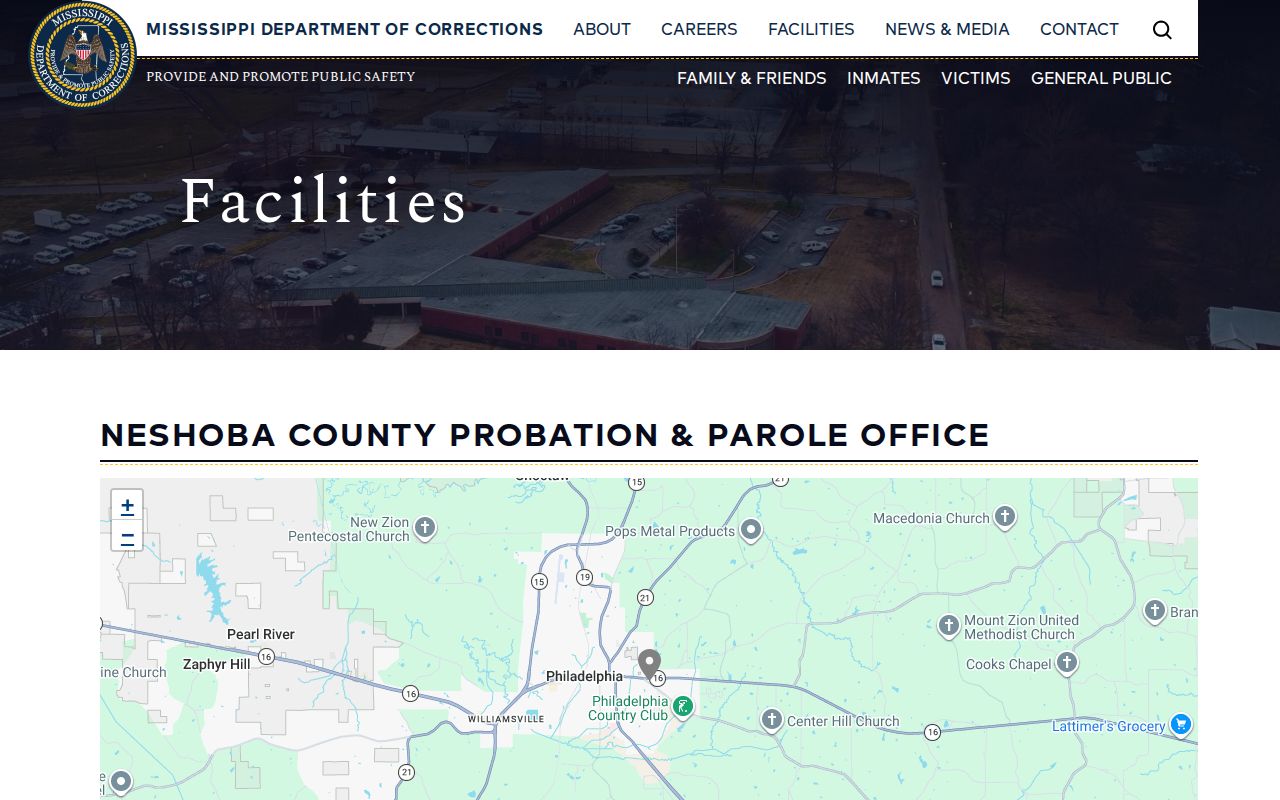
Neshoba Probation and Parole Office
Neshoba County has a dedicated MDOC Community Corrections office in Philadelphia. It is the local procedural and reporting-office layer for people assigned to state parole or probation supervision. The office page names Jason Carney as Community Corrections Director. Office staff can route reporting questions and confirm the correct office process. MDOC policy identifies field-officer records as exempt, so the public should not expect access to private notes, home reports, or other confidential supervision material.
The official Neshoba office listing is the best source to recheck the address and contact details before a visit or call.
Neshoba County Probation & Parole Office
1020 East Main Street, Suite 15
Philadelphia, MS 39350
Phone: 601-656-1701
Fax: 601-656-1693
Community Corrections Director: Jason Carney
The official Community Corrections directory also helps when a person is assigned outside Neshoba County. An office assignment can change, and the supervising county may differ from the conviction county or the place of arrest.
Note: Contact information reflects the July 26, 2026 research sweep and should be checked again before relying on it.
Neshoba Parole Board Record Path
The Mississippi State Parole Board grants, denies, and revokes parole. MDOC Community Corrections does not replace that decision-maker. The Board office is at 239 North Lamar Street, Suite 501, Jackson, MS 39201. Its phone is 601-576-3520, fax is 601-576-3528, and email is MSStateParoleBoard@mdoc.state.ms.us. Ask for the official path for an individual hearing or decision. The research sweep found no verified public calendar or current online results search.
Mississippi law sets eligibility rules, but eligibility is not a promise. For covered offenses on or after July 1, 2014, the principal frameworks in §§47-7-3 and 47-7-3.2 use offense class and other factors. Credits cannot cut the statutory time needed to become eligible. Once a grant occurs, physical release may still depend on MDOC processing, an approved plan, and any other hold. The MDOC FAQ says release processing may take 30 to 45 days and that parole or Earned Release Supervision dates are not guaranteed.
Archived Board minutes may help with historical research, but an archive is not a live decision tool. For current facts, obtain the Board or MDOC record and match it to the person. Then use the releasing facility or discharge certificate to confirm the actual event.
Neshoba Supervision Changes and Violations
Supervision conditions come from the governing order and state process. They can include reporting, approved residence, treatment, fees, travel limits, or other terms shown in that person’s record. A general list cannot establish an individual condition. Read the order, Board record, or lawful MDOC material instead. A violation allegation also does not prove a final finding. It can lead to a hearing, changed conditions, an arrest, revocation, or return to custody.
No official public Neshoba County absconder or warrant list was found. An absconder label means alleged noncompliance or an unknown location. It does not erase the earlier release event. It may signal a later return-to-custody process. Verify an alert with MDOC and the proper court or law-enforcement source, and do not rely on an unofficial list. Mississippi SAVIN can provide changes such as absconding supervision or return to custody when the source system and registration cover that person.
When systems conflict, compare update times and identifiers. The parolee record, Board action, county booking, and court docket may each describe a different stage. Preserve them as a timeline rather than merging them into one status.
Correct Neshoba Supervision Records
An online entry can be incomplete or wrong. Neshoba County’s written public-record policy provides a concrete route for a county booking or release record. Identify the person, booking number if known, bounded dates, and exact fields sought. Ask for the booked time, release time, release method, and receiving agency if a transfer occurred. Keep the written response. If the county denies access, its policy allows a written petition for internal review.
The county administrator must affirm or reverse the denial within two business days after receiving that petition. Ethics Commission or chancery-court review can follow under §25-61-13. This route concerns county-held records. A state parole, probation, or discharge record belongs with MDOC or the Board. MDOC accepts written public-record requests and may redact exempt parts while releasing nonexempt material. It will not create a missing record or disclose protected field-officer files.
Request the record that answers the disputed fact. For state custody, that may be a discharge certificate, actual release type and date, or nonexempt time-computation field. For probation, it may be the court order or completion entry. A blank field should be described as “not shown in this source,” not as proof that no supervision or discharge exists.
Neshoba Supervision Discharge Records
Supervision ends through an official discharge or completion process, not merely because no recent contact appears online. Final discharge means the sentence or supervision described by the record has ended. Parole can also be revoked before discharge. Probation may end through successful completion, a court order, revocation, or another disposition. The exact document depends on who imposed and administered the term.
For parole, connect the MDOC ID to the Board action, parolee record, and final state documentation. For probation, review the sentencing court docket and any MDOC completion record. MDOC Records can be reached at PO Box 24388, Jackson, MS 39225, 601-933-2889, or MDOCRecordsDepartment@mdoc.state.ms.us for its record route. A phone response is useful for navigation, but a written record is more durable.
Keep custody and supervision separate through the last step. A person may be out of jail yet on parole or probation. Another may finish supervision while a different open case remains. The record should state only what the cited agency actually confirms.
Note: A court case marked closed is not, by itself, proof of physical release or discharge from another agency’s supervision.