
Neshoba Projected and Actual Release
MDOC uses the exact public label Tentative Release. “Tentative” means the date is a forecast. It comes from the sentence, lawful jail credit, eligibility rules, earned time, and data held by MDOC when the page is viewed. The public detail warns that state law can cause release types and dates to differ. A tentative date does not confirm that a gate release took place. The actual event is best shown by a discharge certificate, release record, or updated official status.
County custody works another way. A person awaiting trial at the Neshoba County Law Enforcement Center often has no fixed date. Release may turn on bond, recognizance, a judge’s order, dismissal, sentence credit, or another agency’s hold. The local Arrest/Release report can later show the precise processed time and method. If it says transferred, the county booking ended but custody continued elsewhere.
| Record phrase | What it establishes | What it does not establish |
|---|---|---|
| Tentative Release | MDOC’s current projected date | That release occurred or will occur unchanged |
| Parole eligibility | The point when Board consideration may be allowed | A grant or physical release |
| Released timestamp | The local custodian processed an exit | Community freedom if the method was transfer |
| Discharge certificate | Official completion described by MDOC | The outcome of a separate open court case |
Find Neshoba Projected Release Records
Start with the facility, not just the county named on a charge. The MDOC search is appropriate for a state sentence, including an MDOC inmate housed at a regional facility. It is not the normal source for a Neshoba bond-out. Choctaw Adult Detention is a separate tribal system, and its release question belongs with Choctaw Detention or Choctaw Court. A federal sentence belongs in the BOP locator, where a release date refers only to BOP custody.
- Identify the present or last custodian and collect the full name, date of birth, booking number, MDOC ID, or BOP register number that applies.
- For an MDOC sentence, open the Mississippi inmate search. Search by first name, last name, or MDOC ID.
- Open the matching detail and compare MDOC ID, date of birth, conviction county, offense, sentence date, location, and Tentative Release.
- For a Neshoba jail case, obtain the sentencing or bond order and ask the jail for its release computation or processed event.
- Check the separate parolee search only when parole or post-release state supervision is relevant. Do not turn an eligibility date into a grant.
- Confirm an actual state release through MDOC Records, the case manager, a discharge certificate, or the official time record.
The Neshoba County release-record search path explains how the jail report, court docket, and records request fit together for local bookings. Keep each custody episode distinct. A person may leave the county jail, enter MDOC, later reach parole, and eventually discharge. Each step has its own date.
Note: Record the retrieval date whenever using a dynamic MDOC detail because the time computation can later change.
Neshoba Release Date Computation
MDOC time computation begins with the sentence structure and eligible credit. The county of conviction supplies lawful pre-sentence jail credit on the cause number. MDOC uses that credit to establish the sentence-begin date. The agency’s handbook says the computation establishes parole dates, Earned Release Supervision dates, tentative release or discharge dates, and maximum-release dates. Concurrent sentences run together as ordered, while consecutive sentences run one after another. A wrong credit amount or sentence interpretation can move every later milestone.
Offense date and classification matter. For covered offenses on or after July 1, 2014, Mississippi Code §47-7-3.2 generally prevents release before the lesser of 25 percent or ten years for covered nonviolent crimes, 50 percent or twenty years for violent crimes under §97-3-2, and 60 percent or twenty-five years for armed robbery, drive-by shooting, or carjacking. Life, habitual, specified sex-offense, and trafficking categories are outside this general framework. Section 47-7-3 contains further parole thresholds and exclusions.
The statute provides rules, not a hand calculator for an individual case. A court amendment, excluded offense, consecutive term, or hold can make a simple percentage wrong. The case manager and MDOC timesheet are the operational sources. Ask MDOC Records for existing nonexempt computation fields instead of requesting a new legal analysis.
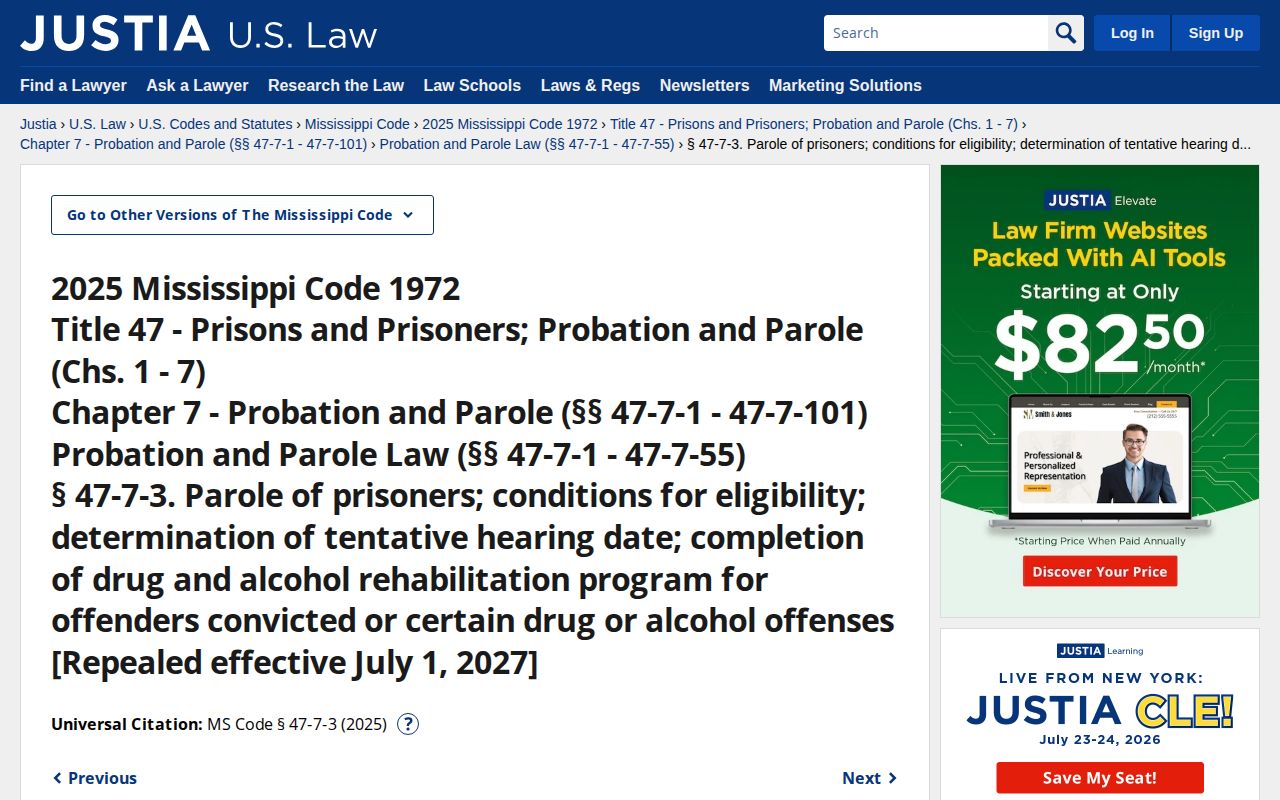
The official parole eligibility statute shows why the sentence and offense category must be checked before estimating a Neshoba-related state release.
Neshoba Earned-Time Release Rules
Mississippi Code §47-5-138 states a 4.5-day allowance per 30 days for covered sentences after June 30, 1995, with a 15 percent cap. That cap is the source of the common phrase “serve 85 percent.” It is not a universal promise that every Mississippi inmate will serve exactly 85 percent. Eligibility minimums, excluded offenses, sentence dates, discipline, and the form of release all affect the result.
Earned time can reduce a covered computation, but it cannot always cut the minimum period needed for parole eligibility. The 25, 50, and 60 percent frameworks can interact with the 15 percent cap. Parole is discretionary, meaning the Board may grant or deny it even after eligibility. Earned Release Supervision also remains within MDOC jurisdiction and requires an approved in-state residence. Neither is the same as final discharge.
- Earned time
- A lawful sentence credit earned under the governing rules.
- Parole eligibility
- The earliest point when the Board may consider release, not a release order.
- ERS
- Earned Release Supervision, a discretionary community placement still under MDOC jurisdiction.
- Maximum release
- The sentence endpoint in the official time computation, subject to the controlling record.
- Detainer
- A notice that another authority may take custody when the current custodian releases the person.
Do not apply this state-prison formula to a local Neshoba jail sentence. No official county good-time rule was found in the research sweep. The sentencing order, credited time, and jail’s own release computation control that path.
Why Neshoba Release Dates Change
A projected date changes when an input, legal rule, or custody decision changes. Some updates move the date earlier. Others move it later or change the form of release. A passed date without a release record is not enough to claim the person left custody. Check the latest MDOC detail and then seek the operational document.
| Factor | Possible effect | Best confirmation |
|---|---|---|
| Corrected jail credit | Changes the sentence-begin date and later milestones | Sentencing record and MDOC timesheet |
| Earned-time accrual or forfeiture | Moves a covered tentative date | Case manager or time-computation record |
| Amended court order | Changes sentence length, credit, or structure | Filed order and updated MDOC record |
| Concurrent or consecutive ruling | Changes whether terms overlap or follow each other | Judgment and MDOC computation |
| Detainer or receiving hold | Changes a community exit into a transfer | Release document and receiving-agency notation |
| Parole or ERS decision | Changes the possible release route and timing | Board or MDOC decision plus actual release record |
A detainer is especially important. It asks the current custodian to hold or transfer the person for another authority. The county or MDOC can relinquish control while another agency immediately assumes it. Report that event as a transfer unless the record supports release to the community.
Neshoba Jail Release Date Channel
No official Neshoba County good-time computation, standard release hour, or weekend and holiday release rule was found. That gap should not be filled with the MDOC formula. For a local jail sentence, start with the court’s sentencing order and credited days. Then call the Neshoba County Law Enforcement Center at 601-656-1414 for immediate navigation or submit a written request for the existing jail-docket and release records.
A strong request gives the name, date of birth if known, booking number, cause number, and bounded dates. Ask for the booked timestamp, released timestamp, release method, and receiving agency on transfer. If the issue is a jail sentence calculation, ask for the existing release-computation fields or record rather than asking staff to create a new forecast. Written county requests go through the Chancery Clerk by form, letter, fax, or email. Telephone and in-person requests do not qualify under the county policy, though in-person inspection is available after the record process.
Neshoba County Law Enforcement Center
920 Chestnut Street
Philadelphia, MS 39350
601-656-1414
Use the jail for local release processing, not an MDOC sentence estimate.
The local Arrest/Release report documents actual events with minute-level dates, times, and methods. It is a dated multi-day artifact, not a projected-date calculator. A blank release field means only that the printed source did not show a release for that entry at print time.
Note: County jail release and MDOC discharge are separate records even when the same person appears in both systems.
Confirm Neshoba Actual Release
Use the most direct final record. For an MDOC sentence, a discharge certificate or official time record outranks a tentative public date. The MDOC FAQ says a case manager supplies an exact release date and that the release process may take 30 to 45 days. MDOC Records can provide the route for a nonexempt discharge certificate, actual release or discharge type, and time-computation material. Its records phone is 601-933-2889, and the mailing address is PO Box 24388, Jackson, MS 39225.
For an upcoming custody change, Mississippi SAVIN can send a notice if the person and source agency are covered. The Neshoba VINELink inmate search explains specific-person registration and the phone PIN step. Treat an alert as a prompt to confirm with the custodian, not as a discharge certificate.
A written MDOC request should identify the person by name and MDOC ID, then ask for existing nonexempt records rather than a new calculation. Useful items include the discharge certificate, actual release or discharge date and type, and time-computation fields showing credited jail time and applicable milestones. Electronic copies may be requested. If MDOC withholds part of a record, ask it to identify the authority and release any reasonably separable nonexempt material. Its policy says the agency normally responds in writing within seven working days and, when material can be disclosed, ordinarily produces it within fourteen working days after any required payment unless more time is needed.
Finally, check the next custodian when a transfer or hold appears. An MDOC location update can show continued state custody. A BOP result marked Released or Not in BOP Custody speaks only to BOP. Choctaw detention questions remain with the tribal system. The projected date becomes historical fact only when the right source documents what happened.